

Mobicube?
Single-Cell 3’ RNA-seq Kit
Immune cells can prevent the body from bacteria and viruses, and are the "police" of the human body. Among them, T and B cells from bone marrow and blood are at the top of the list in terms of force value, and can be said to be the "criminal police" in the human body, and have been widely attention in scientific research. However, to maintain the health of the body, not only the "criminal Police" is needed, but also the "grassroots police" in the lungs, liver, intestines, spleen, intestines and other non-lymphoid systems.
Although the function of the "grassroots police" in each organ is very important, it is not easy to study - previous studies of immune cells using single-cell sequencing technology have often been limited to a particular tissue or organ, to the point of typing and annotation of immune cells. criteria may vary widely across organs and tissues. As a result, researchers lack uniform rules for immune cell annotation and nomenclature across organs and tissues, making it difficult to conduct more in-depth and systematic studies of the immune system.

Construction of uniform immune cell annotation and nomenclature rules
To address these challenges, researchers from the Wellcome Sanger Institute and the University of Cambridge recently published a Science article on their construction of a unified, comprehensive immune cell catalog.
The researchers integrated 19 immune cell single-cell sequencing public datasets from 20 tissues to build CellTypist, a cross-tissue immune cell database that automatically annotates cell types.
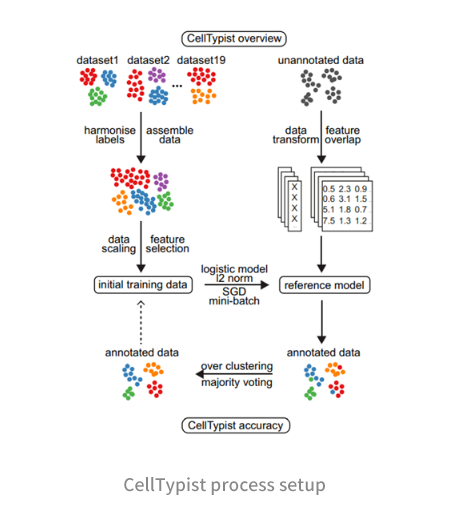
After completing the construction of CellTypist, the researchers validated the function of CellTypist in identifying and annotating immune cells at low/high resolution, respectively. They found that CellTypist could quickly distinguish monocytes and macrophages at low resolution; at high resolution, CellTypist could clearly distinguish naive B cells from memory B cells, accurately identify DC1, DC2 and migrating DCs (migDCs) in dendritic cells, and differentiate αβ-type T cells from γδ-type T cells. Subsequently, the researchers further validated the ability of CellTypist in a real-world application. They sorted immune cells from 12 adult donors and 16 tissues for single-cell sequencing, obtaining a single-cell dataset of approximately 360,000 cells, which were analyzed and annotated with CellTypist.
Cross-tissue characterization of immune cells
The cross-tissue atlas of these 360,000 cells allows easy visualization of immune cell characteristics in different tissues and organs. For example, both the spleen and lymph nodes are rich in B cells, but the spleen also contains many red marrow macrophages, while the lymph nodes are rich in dendritic cells. On the other hand, the bone marrow contains a unique population of progenitor cells. The lung and liver contain significant numbers of monocytes.
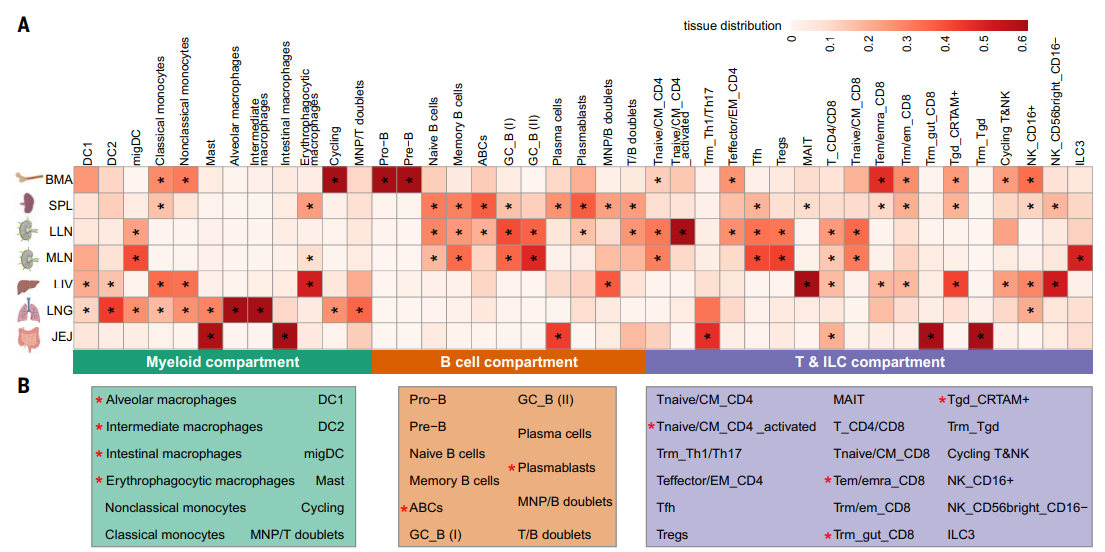
Cross-tissue immune cell atlas
Mesenteric lymph nodes (MLN), Lung-draining lymph nodes (LIN), Jejunum epithelial (JEJEPI), Jejunum lamina propria (JEJLP), Lungs (LNG), Bone marrow (BMA), Blood (BLD), Spleen (SPL), Liver (LIV)
Tissue specificity of macrophages, B cells, T cells
Based on the immune system atlas constructed by CellTypist, researchers also performed cross-tissue analysis of macrophages, B cells and T cells, which have wide-ranging attentions, and observed some interesting phenomena:
Macrophages
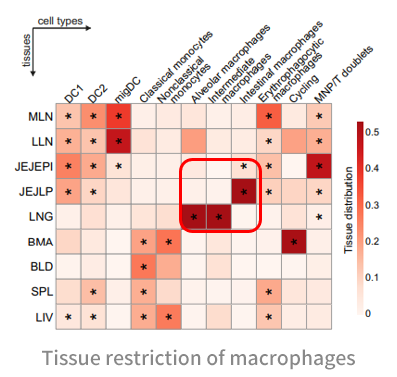
Macrophage cross-tissue organ data showed significant tissue-restricted features, mainly in lung tissue, while erythrophagic macrophages were mainly found in spleen and liver, with iron circulating macrophages aggregated in lymph nodes (circled in red in the figure below).
B cells
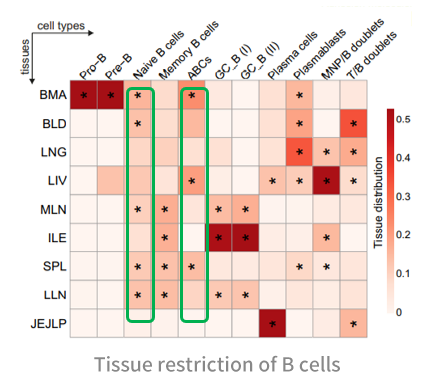
Naive B cells, as expected, are mainly present in lymphoid tissues. CD11c+T-bet+ memory B cells (ABCs), previously reported to be associated with autoimmunity and aging, were found to be present mainly in the liver and bone marrow, as well as in the secondary lymphoid organs, the spleen (circled in green in the figure below).
T cells
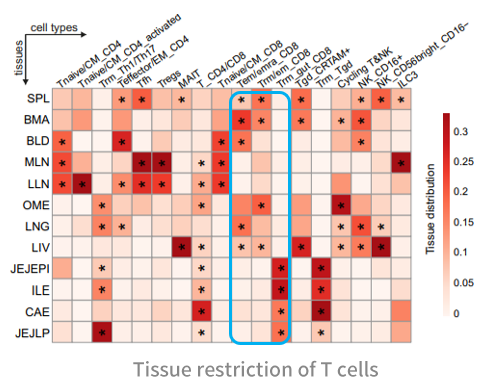
Based on the above data, researchers have completed the first altas of adult myeloid and lymphoid immune cells, which allows us to have a systematic understanding of the immune system across tissue networks. In addition, the CellTypist tool developed by the researchers has far-reaching implications:
CellTypist's cell type annotation of immune cells across tissues using the same rules allows subsequent different researchers to all conduct more systematic studies of the immune system based on the same criteria. To a certain extent, CellTypist has served as a "common thread, common text, and common practice". The researchers have also added the dataset generated in this study to CellTypist, and with the addition of the new data, the number of immune cell types that can be annotated in CellTypist has increased further from 99 to 101. Thus, CellTypist will greatly facilitate the subsequent deeper and more systematic study of the immune system!
C. Domínguez Conde et al., (2022) Cross-tissue immune cell analysis reveals tissue-specific features in humans. Science Doi: 10.1126/science.abl5197